

Ice bath · 0–5°C · 3–5 min
How to stay in an ice bath longer
One song. Get in, finish the song, get out.
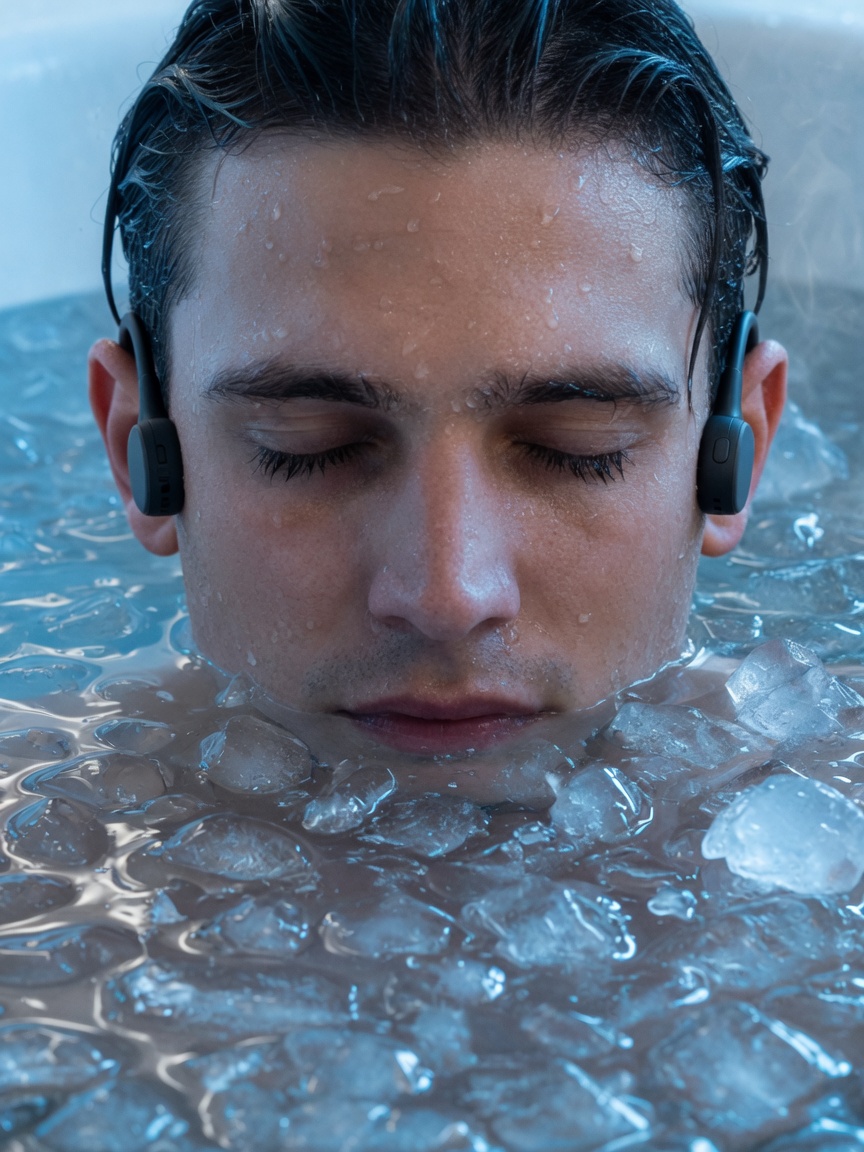
A cold plunge is two or three minutes. An ice bath is three to five. That is the whole event. It should be simple. It is not, because the entire time is the last four minutes.
Heat is dull. Ice is loud. Every second announces itself. You count. You bargain. You check a clock you cannot read because your hands do not work and the phone is in a locker anyway.
People do not fail ice because they forgot the protocol. They fail it because they are alone with the cold, and the cold is excellent at being the only thing in the room.
Why counting makes it worse
Attention stuck on sensation stretches time. In ice, sensation is the entire job. If you watch the seconds, they get longer. If you try not to watch them, you watch them anyway.
Breathing drills help. They also become another thing to perform. A lot of people who “can’t stay in” can stay in. They just cannot stand the administration of staying in.
You need a finish line that is not a number. A song is a finish line you can feel without looking. Get in when the track starts. Get out when it ends. If you picked a three-minute song for a three-minute sit, the session has a shape. You are not negotiating with a clock. You are waiting for a chorus you already know.
Cold plunge versus ice bath
A plunge is often 3–10°C, two or three minutes, in and out of a contrast cycle. Ice is colder, 0–5°C, and you usually sit longer because that is the point of the tub. The boredom and the counting are the same problem. The margin for error is not.
Do not borrow a five-minute ice sit for a first plunge. Do not stack extra minutes because the playlist has not finished. The track is a container for a session you already chose. It is not a dare.
The locker problem
Offline mode, because your phone is in a locker and your hands don’t work anyway.
That is the whole hardware brief for ice. Touch controls fail when fingers go numb. A phone on the lip of the tub is a drop, a crack, or a very expensive ice cube. Waterproof cases still leave you operating a slab with hands that cannot operate a slab.
Bluetooth does not travel through water. If your head goes under, the stream dies. Even if you sit with ears above the surface, a phone on a bench across the room is a weak, wet radio. The reliable version is storage on the headset and buttons you can find by feel.
What to play
Pick the track before you fill the tub. Something you know. Something with a clear ending. A podcast chapter works if you are already in the habit; a song is cleaner because the duration is obvious.
Load it at home. Walk in empty-handed. You should not be pairing anything while you are already shivering.
Open-ear bone conduction leaves the canal empty, which matters when you still need to hear a timer, a friend, or yourself. Keep the volume down. If the ice is trying to tell you something, you should be able to hear it over the mix.
Safety
Numb is not a finish line. Violent shivering, slurred speech, confusion, or the sense that you cannot think — get out. Hypothermia does not wait for the outro. Audio is for the minutes you already planned. It is not a way to override the body, and it is not medical advice. Follow the cold-exposure guidance that applies to you.
Contrast: hot, cold, repeat
The hard part of contrast is not either room. It is the reset. Wet hands. A timer. A phone you should not be holding. A playlist that stops when you duck under.
A cycle that runs the whole loop — sauna, plunge, sauna — only works if the device can do both ends of the temperature range. Swim headphones that are happy in a pool are often explicit about not sitting in 90°C. Everyday earbuds that survived a commute will not survive the stack. There is a separate page on headphones in a sauna if that is the part you are currently destroying.
What Dipsana is for
Dipsana is pre-launch bone-conduction audio rated 0–110°C. IP68, submersible to 2 metres. 32GB onboard. Bluetooth 5.4 above water; offline MP3 below. Physical buttons. Magnetic charging, no ports. Heat-stable pads, not silicone, because the same pair has to walk from the tub back into the heat.
Other bone-conduction swim headphones exist and are often the right tool if water is the only room you care about. Ice is still water. The differentiator here is the full range: you do not put one pair down and pick up another between the bench and the plunge. More on that in how it works.
It is not shipping yet. Join the waitlist if you want the email when it is. One note. Not a drip.